
Archive Notes
The Maharani's Emeralds
Vikas Chand Jain · Amichand Studio Archives · June 1, 2025
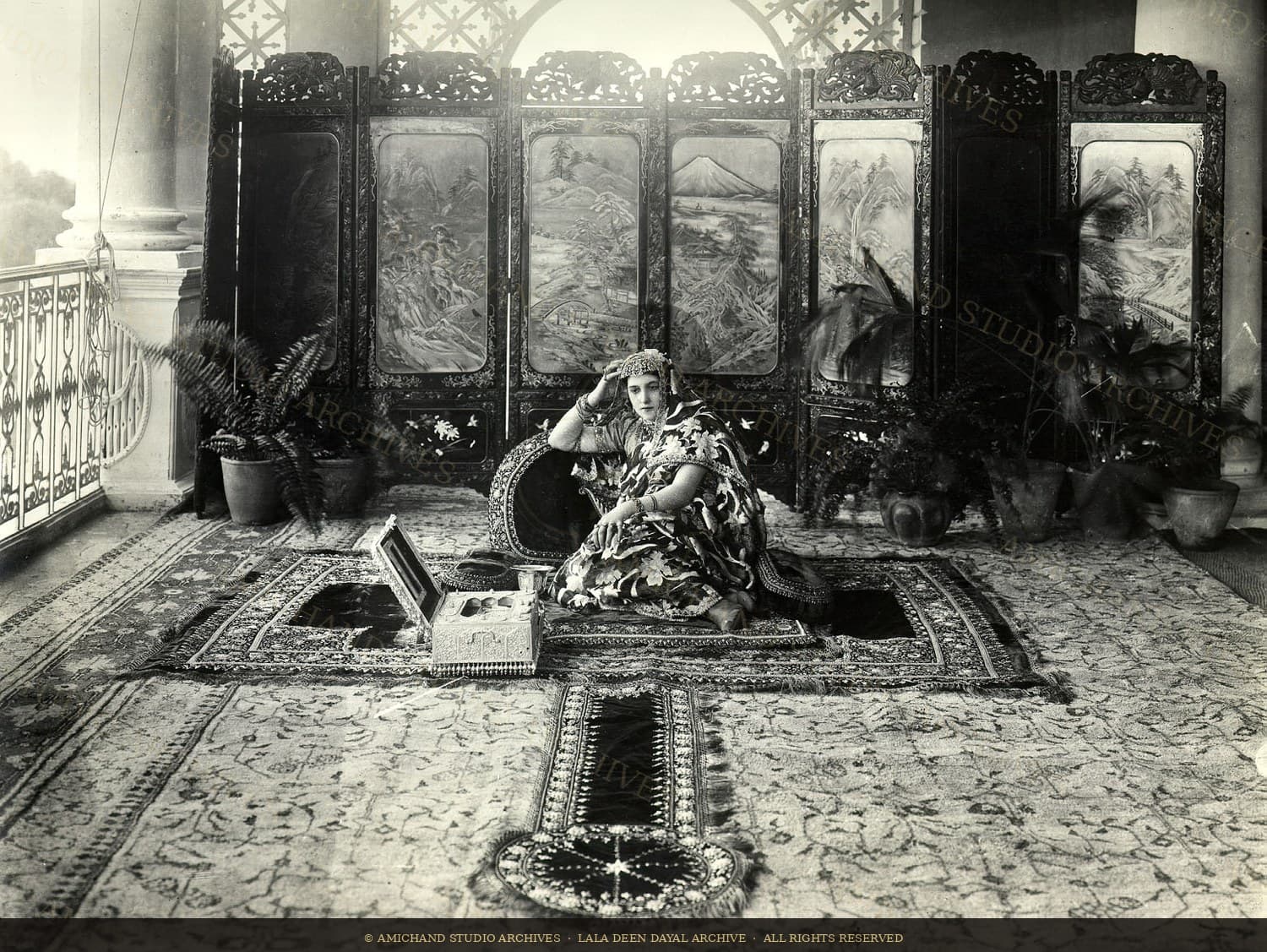
Among the many thousands of plates in the Amichand Studio Archives, there are some photographs that carry stories far larger than their physical dimensions would suggest. The portrait of Maharani Prem Kaur of Kapurthala — born Anita Delgado in Málaga, Spain, in 1890, before her improbable transformation into an Indian queen — is one of them.
This image was made by Raja Deen Dayal & Sons during the Maharani's state visit to Hyderabad in 1914–15, accompanying Maharaja Jagatjit Singh of Kapurthala. She is photographed seated, composed, wearing a saree and the gifts of jewellery presented to her by her host: Mir Osman Ali Khan, the seventh Nizam of Hyderabad, and at the time of his rule, the wealthiest man in the world.
The gift, as it turned out, carried a story that has circulated in the drawing rooms of Indian royal history ever since.
At a formal dinner held in her honour, the Nizam arranged for a set of magnificent deep-green emeralds to be folded inside the Maharani's dinner napkin — a gesture of extravagance meant to express the admiration of a man who was not, by temperament, given to extravagance. When Anita later had the stones examined by a jeweller, they were found to be high-quality imitations: glass, or perhaps doublets, crafted to resemble the real thing with considerable skill.
The irony has endured for over a century. The Nizam was a man who famously wore the same fez for decades, who used a 185-carat diamond — the Jacob Diamond, one of the finest ever found — as a paperweight on his desk, and who was said to smoke half-cigarettes to economise on tobacco. That this same man should gift a visiting queen with fakes is the kind of detail that history cannot resist.
What adds texture to the story is its counterpoint. Anita's own husband, Maharaja Jagatjit Singh, was a man of entirely different appetites. He had gifted her a genuine, massive crescent-shaped emerald that had originally adorned his most prized elephant — offered only after she successfully learned Urdu and Hindustani, proof of her commitment to her adopted world. The contrast between the two gifts, and the two men who gave them, tells something of the range of the princely world that my great-great-grandfather moved through with his camera.
I do not know whether Deen Dayal was present at that dinner. He was not a guest at such tables. But he was trusted enough to be summoned the following morning — or perhaps the morning after that — to make these portraits. The seated image is calm, formal, slightly removed. Whatever Anita may have thought of the emeralds, she gave nothing away.
That, perhaps, is its own kind of composure.
— Vikas Chand Jain